The Wardrobe That Needed a Pronunciation Guide: Twelve Months of Dressing in Colors Nobody Can Say
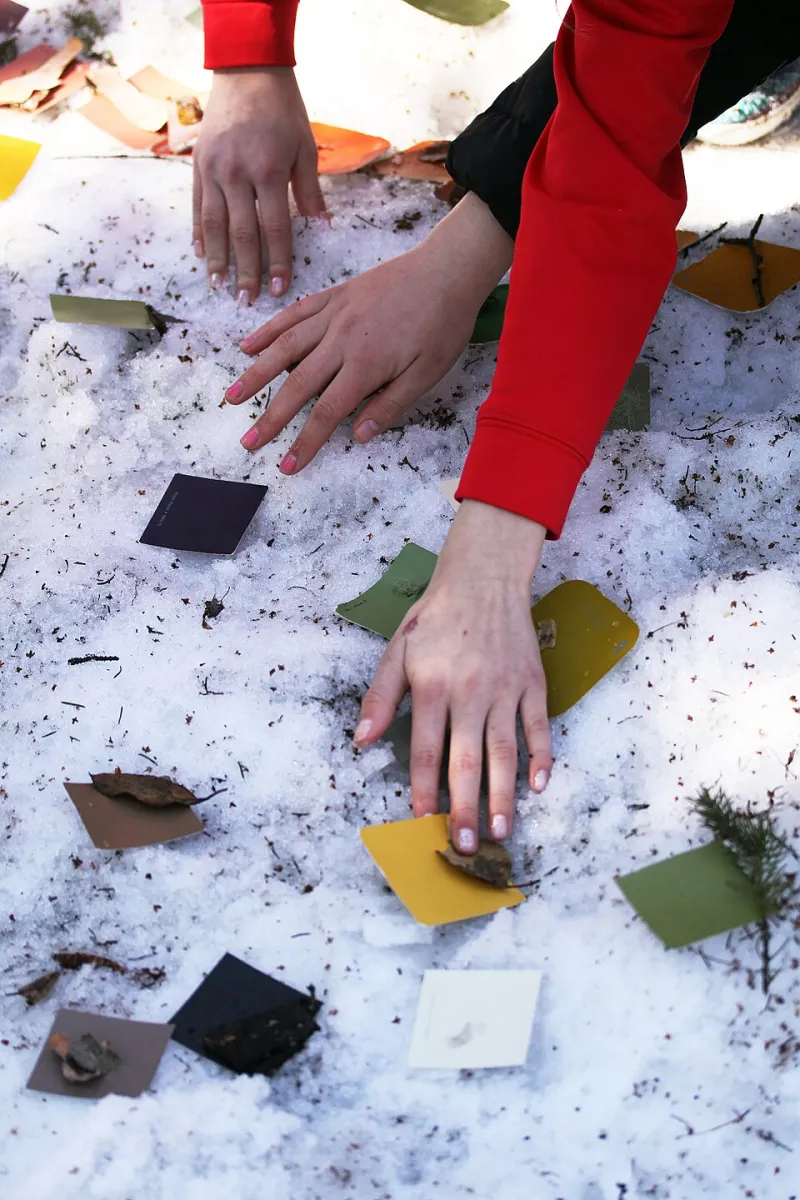
Photo: BLM Alaska, Public domain, via Wikimedia Commons
It started, as most of my worst decisions do, at a paint store in Pasadena.
I was there to buy white. Just white. Instead I left with a fan deck of 3,000 color chips, a sample card for something called Verdigris Haze, and the sinking realization that I could not, under oath, tell you what color I was wearing. "Blue?" I'd been saying, for years. What a poverty of language. What a small, sad word for a person who claims to be creative.
So I made a rule, because rules are how cowards do performance art: for twelve months, I would only wear colors whose names I could not pronounce with confidence. If a stranger could say it, I couldn't wear it.
January: Cerulen-ish (Ish)
The first casualty was my entire closet. Navy, gone. Denim, technically pronounceable, gone. What remained was a single thrifted shirt in a shade I can only describe as Cerulen-ish — and I want to be clear that the "-ish" is load-bearing. It's not cerulean. It's not cyan. It's the color of a swimming pool at dusk, if the pool had given up.
I wore it to a coffee shop in Silver Lake and a barista asked if I was "in a band or in a PhD program." I said yes. The color had given me a whole identity before 9 a.m.
The Swatch Cards
I started documenting each month with a homemade Pantone-style card — because if the wardrobe has a vocabulary, it deserves a brand system. I taped actual fabric to cardstock and wrote the names in a font I stole legally from a friend.
- February — Periwinkle Blush: The color of a wedding where nobody cries. Pronounceable only if you've had coffee.
- May — Chartreuse Deeper: Not chartreuse. Deeper than that. A green so committed it made a Whole Foods cashier call me "a whole vibe."
- August — Vermillion Adjacent: Legally I believe this was orange. Spiritually it was something else.
- November — Smoked Aubergine, Loosely: I looked like a dignified eggplant. I have never felt more powerful.
What Happens When Your Outfit Has a Bigger Vocabulary Than Your Small Talk
Here's what nobody warns you about: obscure color names are tiny identities, and identities invite conversation. Every month, someone would ask what color I was wearing, and every month I'd have to say something like "it's called Zaffre-Adjacent, I think," and suddenly I was in a fifteen-minute conversation about a stranger's grandmother's kitchen in Ohio.
The colors were doing my socializing for me. I hadn't changed as a person — I'd just outsourced my personality to a fan deck.
By December, the experiment ended the way all experiments should: at a holiday party, wearing something called Citrine Hesitant, when a woman asked if I was "the color guy." Word had spread. I had become a reference in other people's conversations. My wardrobe had a fandom before I had a following.
I've since relaxed the rule. I own a gray hoodie now. But I still can't tell you what gray it is, and honestly, that feels like failure. The hoodie is Pigeon at a Bus Stop. It has always been Pigeon at a Bus Stop. Some vocabularies you can't give back.