Lever of Destiny: The Toaster Manual I Rewrote as a Graphic Novel
Every Warning Label Is a First Act
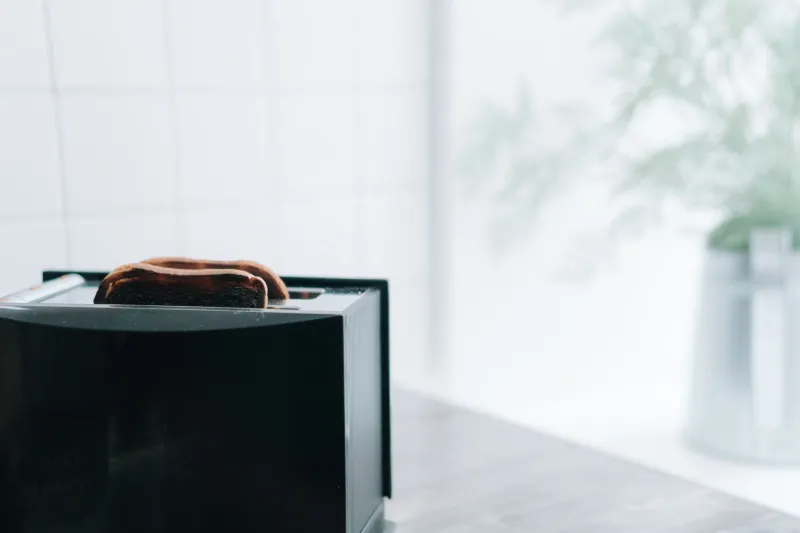
The manual for my toaster is twelve pages long. Eleven of those pages are warnings. The twelfth page is a diagram of the toaster, which is also a warning if you look at it long enough. The language is not designed to be read. It is designed to be survived. 'Do not use near water.' 'Do not insert utensils.' 'Do not operate unattended.' Each sentence is a tiny locked door, and behind every door is a cartoon accident.
I read the manual the way I read a screenplay: looking for the story the writer was too afraid to write. What I found was a coming-of-age epic about a slice of bread who is told, from the moment it enters the kitchen, that the toaster is a place of transformation and also a place of danger. The bread does not listen. The bread has a dream.
Panel One: The Kitchen Counter Establishing Shot
In my adaptation, panel one is a wide shot of the kitchen counter at dawn. The toaster sits under a cabinet like a small monolith. The bread is on a cutting board, still in its plastic bag, which in this version is a kind of swaddling. The caption reads: 'It was a Tuesday. The bread did not know it was bread yet.'
The original manual has a warning on page two: 'Do not place toaster on or near a hot gas or electric burner.' I turned this into a chase sequence. The bread rolls past the stove. The stove is drawn as a sleeping dragon with four coils. The bread escapes. The caption reads: 'The burner was hot. The bread was not. This is called tension.'
The Forbidden Lever
The central plot point of any toaster is the lever. In the manual, the lever is described in neutral terms: 'Press lever down until it locks.' In my graphic novel, the lever is the forbidden switch, the thing the bread has been warned about by a chorus of appliance voices. The kettle says, 'Don't.' The microwave says, 'You'll regret it.' The bread says, 'But what if I come out different?'
This is the emotional core of the manual, and I am only slightly joking. The warning labels are obsessed with the lever because the lever is where the user meets the machine. It is the moment of commitment. Every safety manual is a story about what happens when someone pulls a lever they were told not to pull. That is also the plot of most novels.
Crumb Tray as Antagonist
The crumb tray is the unsung villain of the toaster narrative. The manual says, 'Clean crumb tray regularly.' It does not say why. I drew a two-page spread in which the crumb tray is a swamp of old toast memories, a place where forgotten breakfasts accumulate into a kind of geological record. The bread looks into the tray and sees its ancestors: a rye, a pumpernickel, a bagel that thought it was special.
The caption reads: 'The tray remembers everything.'
This is not an exaggeration. The manual's insistence on cleaning is a warning about time. The toaster is a machine that produces heat and also history. The crumb tray is where the history goes. In design terms, it is a footnote. In narrative terms, it is the past catching up.
Design Notes From the Margin
I kept the original manual's typography for the warning labels—bold, all caps, enough white space to suggest a legal department with a sense of drama. But I replaced the instructional diagrams with panels. The result looks like a safety pamphlet that went to art school and came back with opinions.
The back cover of my version reads: 'This graphic novel is based on a true manual. Some events have been dramatized. The toaster is not a metaphor. The toaster is a toaster.'
That last line is a lie. The toaster is absolutely a metaphor. Every appliance manual is a story about trust. You are asked to trust a machine with your breakfast, your countertop, and your morning. The manual says, in effect: 'We have thought about what could go wrong so that you do not have to.' That is not engineering. That is narrative.
The Manual Was Already a Story
I am not the first person to notice that instruction manuals have a voice. The voice is usually panic wearing a cardigan. But panic is a plot engine. The bread in my graphic novel does not die. It gets toasted, which is a kind of ending. It emerges changed, slightly darker, with a story to tell. The lever was pulled. The crumb tray was cleaned. The manual was read.
My toaster still works. I have not inserted a utensil. I have not used it near water. But I have started reading the manual before bed, the way some people read poetry. It is short. It is urgent. And it has a hero who just wants to be warm.