Sorry, We're Closed (Please Read in a Whisper): A Field Taxonomy of Handwritten Door Notes
The Rules of the Field
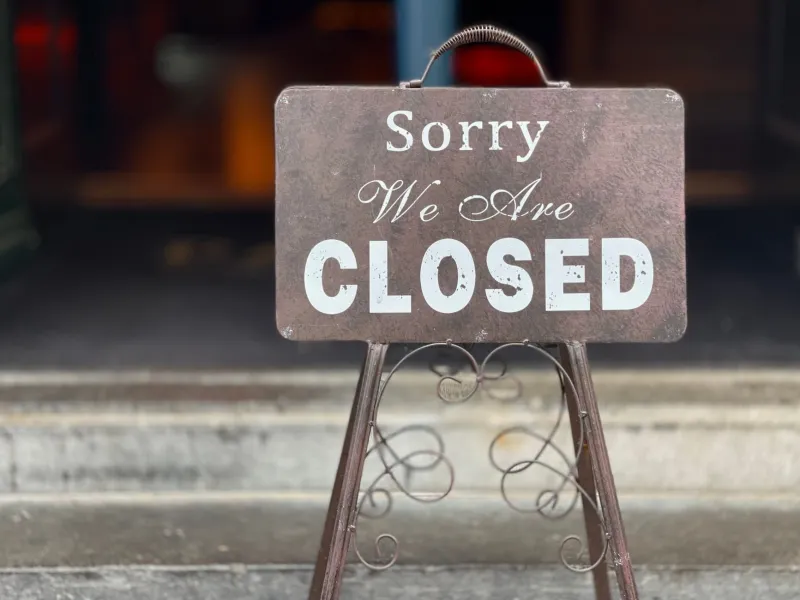
I did not set out to become a scholar of closed signs. I set out to buy a sandwich. The sandwich shop was closed. Taped to the door was a piece of lined paper that said: 'Sorry! Back in 10. Probably.' I stood there for a moment, not because I was angry, but because 'Probably' was doing a lot of work. It was an apology, a threat, and a weather report all at once.
So I started walking. I walked my town—the hardware store, the food truck parked by the library, the bodega with the cat, the nail salon, the auto parts place—and I collected every handwritten sign I could find. I took pictures with my phone. Then I described them to you in great detail, which is cheaper than a photo essay and also more sincere.
Taxonomy One: Typography Under Duress
Handwritten signs fall into three typographic families. The first is Sharpie Baroque: thick, urgent, slightly bleeding into the paper. This is the style of a person who wrote the sign in the car, on their knee, five minutes after they were supposed to open. The letters lean. The exclamation points multiply. The word 'closed' is often written twice, as if once was not enough to convince the reader or the writer.
The second family is Ballpoint Minimalism. Thin, careful, almost apologetic. This is the sign of a person who planned ahead. They used a ruler. They centered the text. They wrote 'We will be closed' instead of 'CLOSED,' which is a way of saying: this is temporary, please do not panic, the world is still turning.
The third family is Crayon Anarchy. Usually found on food trucks and lemonade stands. The letters are large. The spelling is adventurous. The sign is taped at an angle that suggests the tape was applied by a child or a gust of wind. These signs are not meant to be read so much as experienced.
Taxonomy Two: Apology Strategy
Every closed sign is an apology, but not every apology is the same. I identified four strategies.
The first is the Bare Apology: 'Sorry, closed.' No reason. No timeline. The sign trusts you to move on with your life. This is the stoic approach. It is also the most common, and the least satisfying.
The second is the Overshare: 'Sorry, closed! Family emergency, back tomorrow, maybe Thursday, please call my cell if urgent, but not too urgent.' This sign is a short story. It has stakes. It has a phone number. It has a narrator who is trying very hard to be responsible while also being in the middle of something.
The third is the Bureaucratic Dodge: 'Closed for maintenance.' This sounds official. It is not. Maintenance could mean anything from a broken toilet to a broken spirit. The sign does not want to lie, but it also does not want to tell you the truth. It is the Switzerland of closed signs.
The fourth is the Accidental Poetry: 'Closed. The power is out. The cat is fine.' I saw this one at a bodega. I have thought about it every day since. The cat is fine. That is the whole story. That is the beginning and the end of it.
Taxonomy Three: Accidental Poetry
There is a sign taped to the register at my favorite hardware store that reads: 'No cash. Card only. Sorry. The machine is moody.' Moody is the perfect word. It suggests a machine with a personality, a machine that has had a long week, a machine that might come around if you give it a minute.
Another sign, on the door of a nail salon: 'Closed for holiday. Back Monday. Please do not knock. The door is locked for a reason.' That last sentence is not an apology. It is a boundary. It is also, I would argue, a poem about the limits of customer service.
The best signs are the ones that reveal a person behind the paper. A sign that says 'Back in 5' is a sign that says 'I am a human being with a life and I am currently living it.' A sign that says 'Gone to lunch' is a sign that says 'I am hungry and I am not sorry.' I respect that. I have been there.
The Award Ceremony Nobody Sanctioned
I would like to nominate the bodega cat sign for the 2026 Linc Hinaga Unofficial Award for Best Handwritten Closed Sign. It had everything: brevity, mystery, and a commitment to the welfare of a cat. The cat was not on the sign. The cat was, presumably, inside. But the sign understood that the reader's first question would be about the cat, and it answered that question before it was asked. That is not customer service. That is narrative design.
The runner-up is a food truck sign that read: 'Sorry, we're closed. The salsa took longer than expected.' I do not know what that means. I do not want to know. It is perfect.
I walked home after that. The sandwich shop was still closed. The sign still said 'Probably.' I decided to make a sandwich at home, which is not the same thing, but it is close. And if you are reading this and you own a business with a handwritten sign, know this: your sign is being studied. Not by the city. By me. Please keep them coming.